
Fluorescent vs Phosphorescent Pigments: Specify the Light Before the Colour
Separate excitation, afterglow and lightfastness before selecting a coating pigment. Define the light, panel conditions and actual fluorescent grade.

Before choosing a bright pigment for a coating, write down when the colour must be visible. Is the coating viewed while daylight or another excitation source is present, or must it remain visibly luminous after that source is removed? Those requirements lead to different evidence, even when both materials are casually called “glow pigments”.
The distinction matters before grade selection, sample preparation and quotation. It also prevents a second error: treating a striking initial panel as proof of outdoor durability or an approved safety-sign system.
Will the light source still be present?
Fluorescent pigments provide their characteristic fluorescent appearance while suitable excitation is present. Phosphorescent materials are associated with afterglow following excitation. Radiant’s technical FAQ distinguishes these effects and discusses the role of excitation. An expected afterglow should therefore be an explicit requirement, not something assumed from a fluorescent colour name.
For a daylight or UV-lit application, state the light source and the actual viewing situation. For an afterglow requirement, separately state how the material is excited and when and how the appearance must be evaluated after the light is removed. This article does not provide a numerical afterglow criterion or establish a certified system.
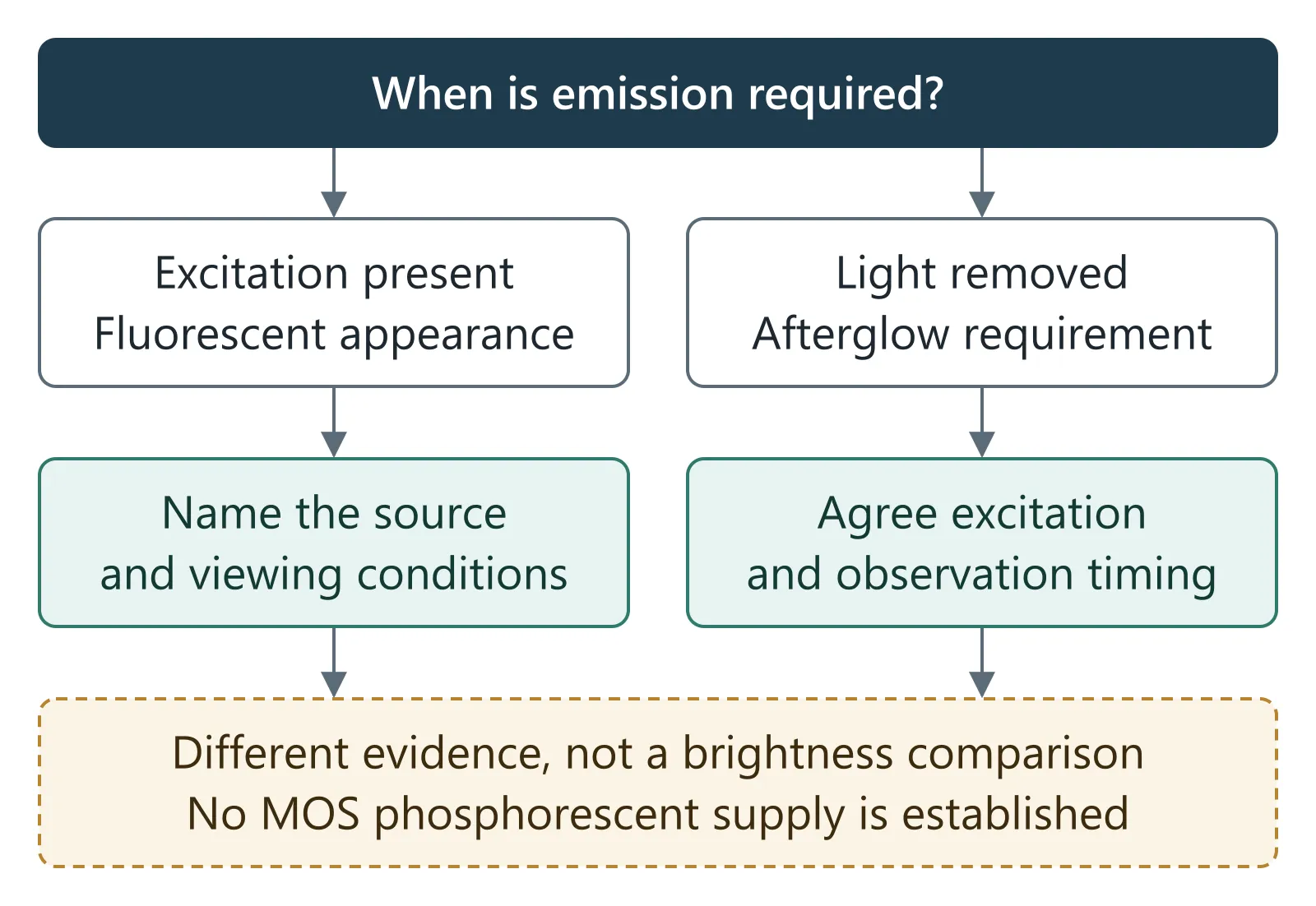
Do not rank samples simply by how intensely they respond under an unspecified UV lamp. The producer cautions that UV response is not a general measure of fluorescent pigment quality. A demonstration under one source may not answer the appearance question under the buyer’s service lighting.
A bright sample is not a durability result
Initial fluorescent appearance and lightfastness are separate observations. The manufacturer identifies binder, pigment loading, film thickness and exposure conditions as influences on lightfastness. A bright fresh panel consequently does not establish how the finished coating will retain its appearance in another formulation or exposure.
Ask what a claimed result actually describes: the exact grade, binder system, loading basis, substrate, preparation, conditioning and exposure method. Distinguish a retained unexposed reference from an exposed specimen and agree the evaluation criterion. A supplier’s broad description of a pigment family is not a service-life guarantee for a buyer’s coating.
The same boundary applies to safety markings. A colour effect or afterglow demonstration is not itself evidence that the finished sign or coating meets the applicable system requirements. No such approval should be inferred from the fluorescent catalogue linked here.
Compare panels under named conditions
Use the intended coating system or a clearly identified agreed screening system. In a first grade comparison, hold the non-test variables consistent and record any unavoidable differences. If binder or film preparation changes at the same time as the pigment, the comparison no longer isolates the pigment change.
| Record before comparison | Why it matters | Do not infer |
|---|---|---|
| Exact pigment grade and supplied form | Identifies what the sample represents | That similar colour names or family names make grades interchangeable |
| Binder, loading basis, substrate and film preparation | Establishes the coating in which appearance is assessed | That a demonstration in another binder predicts the same result |
| Light source and viewing conditions | Defines the excitation and observation question | That stronger response under one UV lamp means better daylight performance |
| Light-present or light-removed observation, with agreed timing where relevant | Separates fluorescent appearance from an afterglow requirement | That the offered fluorescent grade has qualified afterglow performance |
| Conditioning, exposure and acceptance criterion | Separates initial appearance from durability evaluation | That a bright fresh panel proves a universal outdoor life |
Keep a clearly identified reference and record the actual observations without converting them into an unsupported performance curve. If the required optical function cannot be demonstrated under the named conditions, stop the grade selection and clarify the requirement. Increasing pigment loading is not a substitute for selecting the right optical function or validating the formulation.
Enquire for a fluorescent grade, not an implied approval
The MOS Radiant catalogue lists fluorescent pigment series and is the existing route for grade enquiries. The producer’s GXT page is one example of a named fluorescent series; it does not make every series equivalent or approve a specific MOS coating formulation.
Send the intended binder and application, required colour effect, light and viewing conditions, processing constraints, comparison plan, quantity and destination. Ask for the current exact-grade TDS/SDS and appropriate sample guidance. State any durability or system approval requirement separately so the supplier can confirm what evidence is actually available.
The present MOS catalogue establishes a fluorescent enquiry route. It does not establish MOS phosphorescent supply or safety-sign certification. Making that boundary clear at the enquiry stage is more useful than receiving a visually impressive sample for the wrong optical task.