
Minimum Film Forming Temperature: Qualify the Film, Not Just the Number
Separate MFFT, Tg and finished-coating application conditions before comparing waterborne binders or planning a grade substitution.
A binder's minimum film forming temperature is not another name for its glass-transition temperature, and neither number alone qualifies a finished paint for cold-weather application. Before ranking two grades, identify what was tested and what the reported temperature actually describes.
This matters when the MOS Synthomer grade catalogue lists Tg and minimum film-forming temperature in separate columns. Read them as separate records, not interchangeable selection limits. The purchasing question is whether an identified dispersion can support the intended formulation and application trial—not simply which catalogue number is lower.
Three temperatures, three different questions
MFFT concerns formation of a continuous film from the tested dispersion under a defined procedure. Tg concerns a material's glass transition under its reporting basis. The Rhopoint instrument manual explicitly distinguishes the two. Do not replace a missing MFFT result with Tg or apply a universal correction between them.
| Reported record | What it can help answer | What it does not establish |
|---|---|---|
| Method-qualified Tg | How the identified material's transition was reported | The dispersion's measured film-formation endpoint |
| MFFT of an identified dispersion | Under the stated test, where continuous film formation is observed | A finished paint's complete application specification |
| Finished-coating application requirement | Conditions to be respected for the specified coating system | That every binder with a lower catalogue MFFT is an equivalent replacement |
Keep the sample state visible. A result on a supplied binder, a modified binder sample and a fully formulated paint describes different material. The same abbreviation in a spreadsheet does not make those samples comparable. Ask for the procedure, preparation, conditioning and endpoint alongside the temperature; an unexplained number leaves the comparison unresolved.
Separate the binder screen from the coating trial
A binder screen asks how a particular dispersion forms a film under the chosen test conditions. A coating trial asks what the actual formulation does on an identified substrate during application and drying, followed by the agreed film tests. Keep both records rather than letting the first stand in for the second.
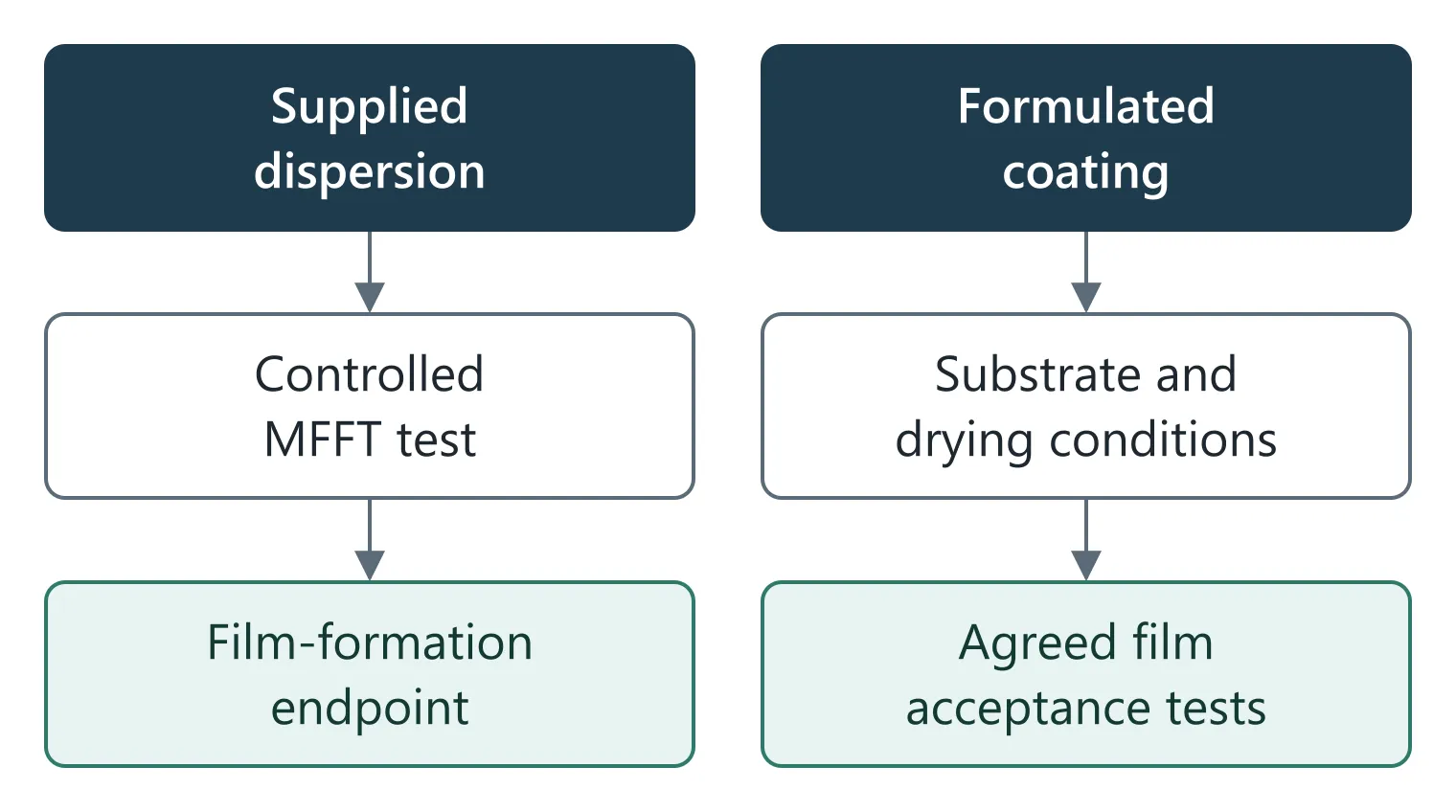
Hempel's waterborne-coating guidance describes water loss, particle coalescence and the role of coalescing agents. It also treats paint and substrate temperature and the drying climate as application considerations. This is guidance for the manufacturer's coating systems, not a universal MOS temperature, humidity allowance or coalescent dose.
Consequently, a favourable binder MFFT is a screening datum, not a finished-paint release decision. The binder-plus-additives sample may have a different basis from the supplied dispersion; pigments, other formulation components and preparation must remain identified. If a coalescent is deliberately changed, record its identity and dose basis instead of attributing the entire difference to the binder grade.
A surface that looks dry is not, by itself, proof of an adequately continuous film or retained end-use performance. Equally, whitening or cracking cannot identify a single cause without the sample and drying history. Separate an observed film-formation problem from its diagnosis: check the test and preparation record, then compare controlled samples before changing the chemistry.
Agree a grade comparison that can be used
For an initial binder substitution, retain a reference and change the identified grade while keeping the planned formulation and preparation basis comparable. If a compensating formulation change is necessary, name it; the result then belongs to that combined change. Do not describe two different coalescent packages as a binder-only comparison.
An interpretable trial record includes:
- The exact reference and candidate grades, lot identities and whether each sample is supplied dispersion, modified binder or finished paint.
- The MFFT procedure and endpoint, sample preparation and conditioning; keep an independently reported Tg on its own method basis.
- For coating trials, the formulation, substrate, application method, film thickness and recorded drying conditions, including their changes over the evaluation period where relevant.
- Agreed film-formation observations and the separate tests needed for the intended use, evaluated at the same defined conditioning stage.
Agree the relevant acceptance criteria before inspecting the panels. A continuous-looking film does not alone demonstrate adhesion, corrosion resistance, water resistance or durability; those properties need their own appropriate assessment. Conversely, one failed panel is not evidence that every application of the binder grade is unsuitable. Resolve preparation and condition differences before ranking candidates.
For a Synthomer grade enquiry, identify the waterborne system, present binder, proposed grade change and the application conditions the coating must tolerate. Request current grade-specific TDS/SDS and relevant batch quality evidence, including the basis of any reported MFFT. Add the trial quantity, order scope, packaging and destination. The catalogue provides a real route to grade and sample discussion; this guide establishes no MOS-tested coating result, universal application limit or guaranteed substitute.