
Expanded vs Unexpanded Microspheres: Choose the State Before the Grade
Separate expansion state from wet or dry delivery, then qualify the process, dose basis and density endpoint before selecting a microsphere grade.
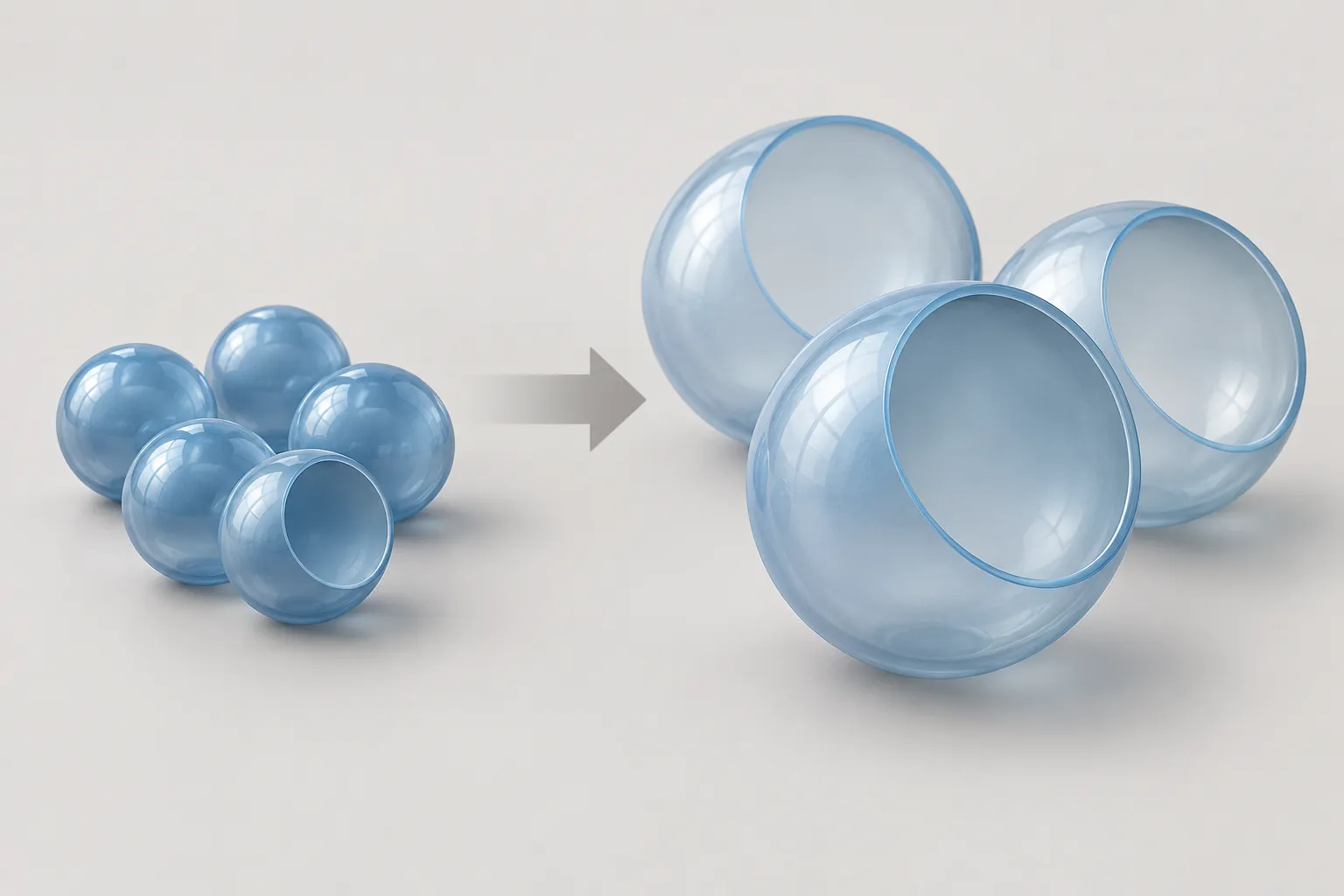
Expanded and unexpanded microspheres answer different processing questions. Buying an already-expanded filler is different from buying a material whose expansion must be achieved in a suitable process. Wet or dry is a second decision: it describes the supplied form, not whether expansion has already occurred.
For a coating, sealant or polymer formulation, put both descriptions on the sample request. “Microspheres for lower density” alone leaves the supplier guessing about the process, liquid phase and measurement basis. It also makes two quotations difficult to compare fairly.
Two independent descriptions belong on the specification
Nouryon’s form guide distinguishes expanded from unexpanded products and wet from dry delivery. Its thermoplastic microspheres contain an encapsulated gas; heating a suitable unexpanded grade softens the shell and permits expansion. That explanation is not a universal processing temperature or permission to heat an unidentified powder.
| Supplied description | Manufacturer form examples | First purchasing question |
|---|---|---|
| Unexpanded, dry | DU | Can the identified process provide the grade-specific expansion conditions? |
| Unexpanded, wet | WU | Are both the expansion requirement and the supplied liquid/solids basis suitable? |
| Expanded, dry | DE / DET | How will the already-expanded filler be incorporated and evaluated? |
| Expanded, wet | WE | Is the supplied wet form compatible with the formulation and dosing basis? |
These labels are screening descriptions, not substitute-grade approvals. Slurry and masterbatch forms introduce further carrier questions. A suffix or similar product number does not establish the same particle size, thermal response or formulation performance.
Decide whether expansion belongs in your process
Nouryon describes expanded DE and WE products as lightweight fillers. For a process without a qualified expansion step, an already-expanded candidate is a sensible starting point for discussion. It still needs incorporation and end-use qualification; “already expanded” does not mean immune to the actual process.
For an unexpanded candidate, ask the supplier to relate the current grade data to the material’s actual temperature history, residence time and incorporation conditions. An oven setting is not necessarily the microspheres’ temperature. A data-sheet expansion onset or maximum, obtained by its stated method, is not automatically the recommended production setpoint.
Keep the reference formulation and identify the variable being tested. If both grade and processing conditions change, record a separate development trial rather than attribute the whole result to expansion state. No general mixer speed, shear limit or expansion ratio is prescribed here.
Compare the material basis before comparing results
Equal kilograms of wet and dry products need not introduce equal microsphere solids or equal carrier. State whether the trial dose is supplied-product mass, documented solids mass or another agreed basis. Use the grade’s actual solids definition and method; do not infer it from the form abbreviation. Adjusting a carrier balance is a formulation change and must be recorded.
Density needs the same discipline. The Expancel WE technical sheet, dated February 2024, distinguishes solids content from true microsphere density and identifies a pycnometer method for the latter. That value is not automatically the bulk density of a delivered wet package, the fresh coating density or the density of a cured film.
Agree which specimen and endpoint matter: fresh mix, stored material or finished film. Keep the relevant preparation and conditioning comparable, then assess the required appearance and service properties separately. Lower measured density alone does not establish acceptable strength, finish, durability or overall cost.
Make the sample request specific enough to decide
The MOS Nouryon catalogue provides an existing route for discussing listed Expancel grades. Request the exact offered grade, expansion state, wet/dry or carrier form, current TDS/SDS and an agreed specification. Where a catalogue and a technical sheet differ, confirm the document revision and measurement basis before selecting a numerical limit.
Send the binder and liquid phase, intended application, actual processing history, current reference material, proposed dose basis and acceptance endpoints. Include sample and order quantities, packaging and destination. The sample plan should say what would keep a candidate, what would reject it and which unresolved result needs further investigation.
The form definitions above come from the identified manufacturer sources. The comparison framework is engineering guidance, not a MOS test result, stock guarantee or universal replacement claim.